Artificial Intelligence and the Future of Teaching and Learning: How AI Will Transform Education by 2030
By the early 2030s, the American classroom is projected to change significantly in both structure and function.
According to education technology experts, cognitive computing will drive much of this change. These systems represent an advance beyond the basic digital tools used in the 2020s, offering embedded intelligence that supports instruction and administrative tasks. Rather than serving only as a student resource, these systems are expected to become a regular part of the educational process, changing established ideas about how curriculum is delivered and what role educators play.
This transition is already apparent in available data. Machine learning architectures that adjust to individual student performance are speeding the move away from standardized, lecture-driven teaching models.
In the coming five years, the continued development of these technologies is expected to produce learning environments that are more responsive to immediate student needs.
The rise of the intelligent learning platform
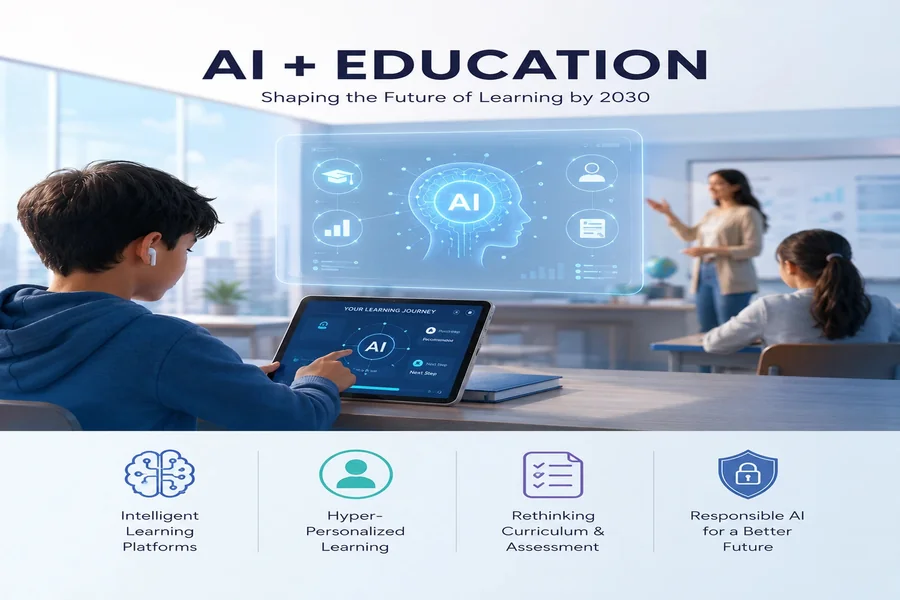
A major factor in this transition is the continued development of the learning platforms. Current versions of these systems are largely used to post syllabi and collect assignments. By 2030, they are expected to function as interactive environments that support personalized instruction.
These systems will be incorporated into the standard routines of students and teachers to collect data on how students work through material. This includes not only whether answers are correct but also the methods students use to reach them.
The system also captures other information, including how much time students devote to particular subjects and the moments when they stop or have difficulty. This data is used to build personalized skill profiles and tailor the material each student receives.
This ongoing assessment allows the platform to modify the curriculum as students work. When gaps are identified, remedial material is introduced. When students show they have mastered a topic, they are moved forward.
This technology enables teachers to shift toward a more facilitative role. By reducing the time required for grading quizzes and handling routine administrative work, educators can devote more attention to:
- Mentoring students on an individual basis;
- Leading classroom discussions;
- Guiding collaborative group projects;
- Offering emotional and social support that no algorithm can replicate.
As a result, the teacher’s primary function moves from delivering content directly to guiding students through challenging material and developing their capacity for critical thinking.
Hyper-personalization and the end of the average student
The idea of a standard curriculum delivered at a uniform pace will likely fade with AI enabling mass customization in education. By 2030, each student is expected to have access to a personal AI tutor. These systems will be designed to understand a student’s learning style, existing knowledge, background, and emotional state by analyzing their interactions.
When a student studies algebra, the AI tutor adapts rather than recycling the same exercise. It might introduce a visual representation, tie the topic to something relevant to the student’s interests, or simplify by breaking it down into smaller parts. For students who have already mastered the content, the tutor would introduce advanced problems or suggest cross-disciplinary applications.
The continuous tailoring is intended to maintain an optimal level of challenge for every learner. Platforms built around this approach are projected to limit learning gaps and drive consistent progress across varying ability levels.
Transforming the educator’s toolkit and role
By 2030, forecasts describe a teacher dashboard offering instant visibility into student performance across the group. It would show engagement levels, locate trouble spots with individual concepts, and signal which students are prepared to move on to higher-level content.
The platform would go further by suggesting concrete next steps: a targeted group exercise for students who are weak in fractions, extra reading material for those seeking greater depth, or a video review for students who missed instruction.
This information can support more informed instructional decisions while allowing teachers to spend less time developing general lesson plans and more time designing collaborative activities. They will use the AI-provided data to address individual student needs more directly.
Administrative tasks are also expected to decrease, with AI managing tasks such as drafting parent communication and assisting with individualized education program components.
Rethinking the curriculum and assessment
The curriculum will likely become more adaptive. Static textbooks can be replaced with interactive resources that are regularly updated. A student working through fractions, for example, might turn to a fraction calculator to visualize the relationship between numerator and denominator in real time. That’s something no printed worksheet can replicate.
Students will be able to explore topics of interest, with AI guiding them to ensure they develop a complete understanding. So, the focus will shift away from memorization toward skills such as analysis, synthesis, creativity, and critical thinking.
Assessment methods are also expected to change. The traditional end-of-term exam may become less common. By 2030, assessment is likely to be ongoing and built into the learning process.
As students use the learning platform, the AI tracks their competency. A student’s record will not be a single letter grade but a collection of demonstrated skills, problem-solving abilities, and completed projects. This AI-compiled portfolio is intended to provide colleges and employers with a more detailed view of what students know and can do.
Challenges and the path forward
AI use in schools has real upsides but comes with major issues: data privacy, algorithmic bias, and the digital divide.
Training on varied, representative data is needed to stop bias from being embedded, a task shared by developers and educators. Unequal access to technology must be addressed, or gains will largely benefit students in wealthier districts. Tight security and data protection measures are non-negotiable for student records.
Looking toward 2030, experts foresee AI helping build an education system that is more equitable, engaging, and efficient. By automating routine aspects of instruction and grading, the technology would allow teachers to prioritize inspiring students, mentoring them, and nurturing skills in critical analysis and creative problem-solving. The process will not be simple, but the potential for an education model that works for every learner makes pursuing it essential.