Design AR/VR Assets Quickly with an AI 3D Model Generator Built for Creators
AR and VR experiences help support across the globe in games, education, and enterprise. Developers are looking for quicker pipelines to create high-quality 3D assets. With traditional modeling, it is time-consuming and difficult to perform iterations rapidly. Tripo 3D provides creators with an array of smart automation and organized workflows for asset creation. It can be used to facilitate faster prototyping, improved collaboration, and scalable content creation for immersive digital environments.
Why AR and VR Projects Require Specialized 3D Assets
Real-time performance is essential for immersion, and hence the need for optimized assets in AR and VR projects. High polygon models can cause a drop in frame rate and cause latency issues with headsets. The developer would need to make sure there is a balance between the visual fidelity and lightweight geometry structures. Texture compression and efficient UV mapping also affect the performance in immersive scenes. Tripo 3D helps achieve this balance by creating assets with a level of structure that allows for clear visuals without unnecessary complexity.
How AI 3D Model Generator Accelerates AR/VR Asset Production
Immersive design production pipelines can be long and include manual adjustments. AI 3d model generator tools streamline this process by automatically generating base meshes and adding structural details. By enabling rapid iteration of assets ready for refinement from simple inputs, Tripo 3D accelerates the process. This enables quicker testing of various design ideas without the need to re-create models again and again. Being able to change things, experiment with ideas, and verify their designs early in the manufacturing process will significantly boost creators to be more efficient in their process and remove development constraints.
Building Immersive Experiences with AI-Generated Assets
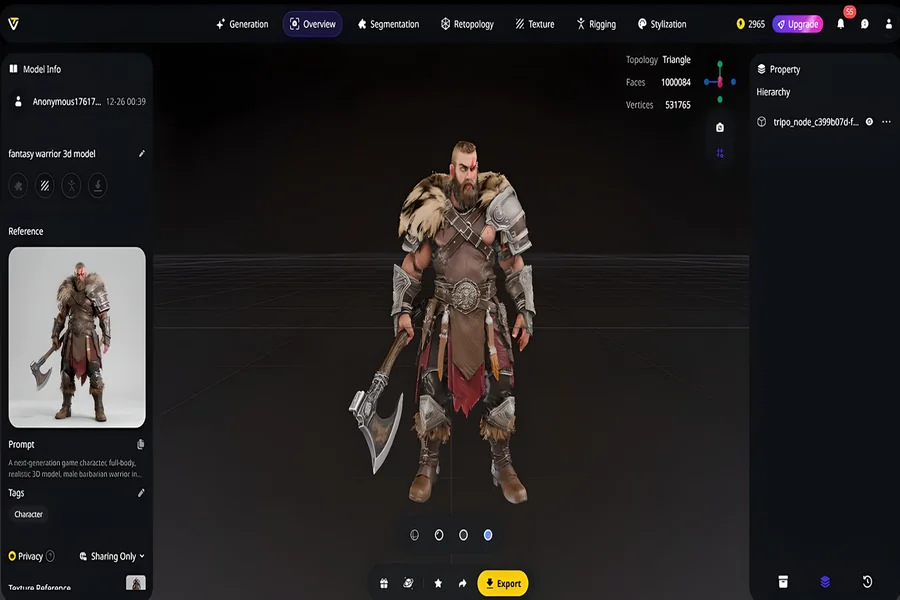
In immersive environments, there are also many different types of assets like props, characters, and environmental objects, and image to 3d conversion can be used to rapidly convert sketches or references into models for use in real-time environments. Tripo 3D is a software for helping designers to add a uniform visual style and structural precision to virtual worlds. These resources are applied towards interactive stories, training simulations, and virtual product displays. The devs can create scalable environments in no time and maintain the consistency of objects, illumination, and spatial arrangement for engaging AR/VR experiences.
Essential Characteristics of AR/VR-Ready Models
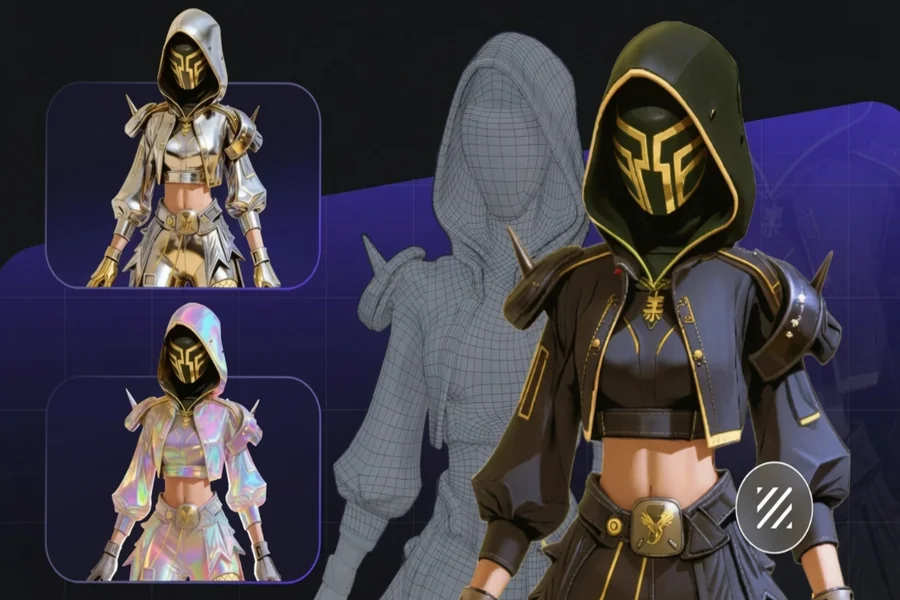
AR/VR models should be cleaned up to have proper topology and as few redundant vertices as possible. The lightweight structures assure smooth rendering of the different hardware devices and the headset platforms. The efficient use of textures enhances the loading time and lowers the memory usage at run-time. When using PBR workflows, the correct setup of materials can be used to create realism without incurring any additional costs. Other key factors in deployment flexibility are engine compatibility, e.g., Unity and Unreal. Tripo 3D creates assets that meet these needs and that are easily integrated into real-time pipelines.
Steps to Design AR/VR assets quickly with an AI 3D model generator built for creators
Step 1: AR/VR Asset Setup and Input
-
First, you need to access Tripo 3D and signup. Next, go to the “Model” tab present in the vertical left menu bar.
-
Open the “HD Model” section to begin building immersive assets.
-
Upload reference images via drag-and-drop or the “Upload” tab.
-
Or switch to “Text to model” to describe AR/VR objects directly.
Step 2: Immersive Optimization Settings
-
Under “General settings”, enable “AI complete” for full automation.
-
Set “Texture Quality” to balance performance and realism for AR/VR.
-
Turn on “PBR” for realistic lighting interaction in real-time environments.
-
Select “Quad” or “Triangle” topology based on engine compatibility.
-
Choose v3.1 best quality, v3.0 fast and balanced, or v2.5 legacy.
-
Activate “Generate in Parts”, “8K Texture”, and “Privacy” if needed for secure asset creation.
-
Click “Generate Model” to start model generation.
Step 3: Visualization and Export for XR Use
-
Preview using “Solid View”, “Cartoon Style”, “Sketch Style”, “Hologram Style”, and “Unlit”. Use “Refine” to improve detail.
-
Adjust the scene using “Environment Settings” and reset the camera via “Reset Camera”.
-
You can also prepare assets for physical output using “3D Print”.
-
Finish with “Export”, choose format and resolution, then click “Export”.
Tripo 3D Features That Support Immersive Content Creation
-
Structured topology generation for clean mesh flow to edit and animate.
-
Immersive realism (surface detail) is created with high-resolution texturing.
-
Automated asset creation reduces the time spent modeling and shortens production cycles.
-
Iteration over multiple design variations is rapid with flexible creative tools
-
Optimization capabilities are implemented to keep assets light in real-time environments.
Optimizing Assets for AR and VR Deployment
When optimizing assets for AR/VR, geometry density and texture resolution are important factors to consider. The number of unnecessary polygons should be minimized for clarity of the visuals, and the silhouette should be accurate. Written description to structured 3d objects for faster prototyping – text to 3d model input. With efficient rendering techniques, frame rates stay consistent among devices. Texture atlasing and compression can help to keep memory usage down while maintaining the perceived quality. Tripo 3D allows you to optimize by developing structured assets suitable for real-time rendering. This will lead to a better interaction experience and performance in virtual environments.
Future Opportunities for AI in Immersive Content Development
AI is revolutionizing content creation and utilization in different industries, including the creation of immersive content. Fast Asset Libraries will allow developers to scale environments more efficiently than ever before. When the generation cycles are much shorter, it is easier to come up with creative experiments. With increasing access to advanced modeling tools, the barriers to development are lowered as more and more non-technical users gain access. Workflow automation will also bring about more integration of the design, animation, and deployment phases into a single system. Tripo 3D helps accelerate in the middle of this change by assisting in the production of prototype-ready models faster for AR and VR ecosystems.
Conclusion
Today, AI’s workflows are transforming the design and deployment of immersive environments. Tripo 3D enhances the production speed in multiple applications while maintaining asset quality. It translates to faster iteration cycles, streamlined development processes, and more scalable pipelines for asset creation for developers. This change will help to increase the use of AR and VR technologies in various industries. AI-generated assets are now a key part of crafting the future of digital interactive experiences.