
GPT-5.6 Luna Benchmarks: Mid-Field Scores With Real Competence Underneath
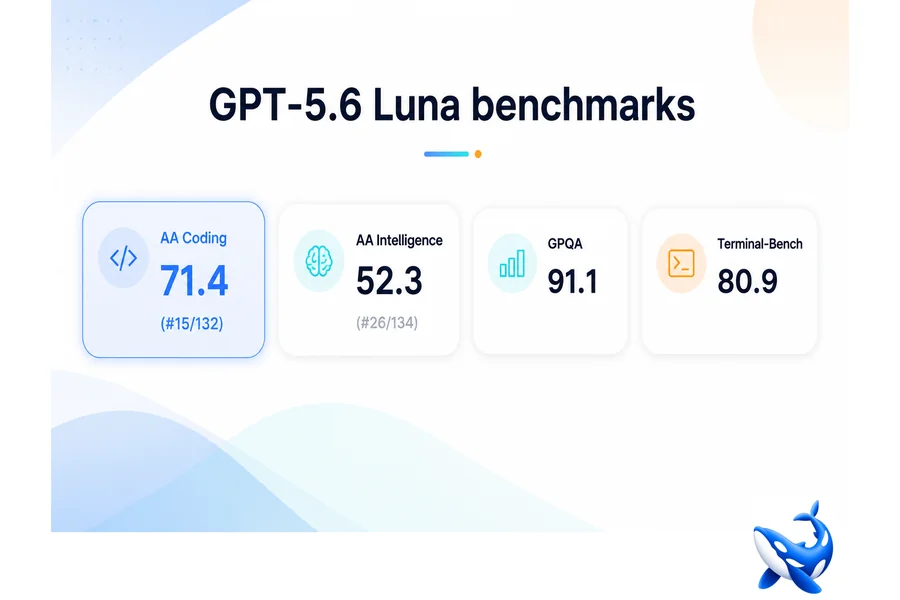
The benchmark story of GPT-5.6 Luna API is different from a flagship’s, and reading it correctly matters more. Luna scores 71.4 on the AA coding index, ranked fifteenth of 132 models, and 52.3 on the AA intelligence index, ranked twenty-sixth of 134. This GPT-5.6 pricing walkthrough shows the scores in the family context.
The honest reading is that Luna is not the strongest model in the field, and it does not need to be. It is a workhorse, and the benchmark question for a workhorse is not “is it the best” but “is it capable enough for the tasks it will carry.” The scores answer that question in the affirmative for the workloads Luna is built for.
The two headline indexes
Luna’s aggregate scores place it in the top fifteen to top twenty-six of the field — solidly mid-field, with real competence underneath. The AA coding index of 71.4, fifteenth of 132, means it sits in the top eleven percent of coding models. The AA intelligence index of 52.3, twenty-sixth of 134, means it sits in the top nineteen percent overall. These are not flagship numbers, and they are not meant to be. They are the numbers of a model that is genuinely capable for the routine majority of tasks, at a price that makes running that majority affordable.
The individual benchmarks
The individual scores add texture. GPQA Diamond at 91.1 shows strong graduate-level reasoning. Long-context recall at 78.3 shows the model uses its one-million-token window. Terminal-bench 2.1 at 80.9 shows solid tool use for lightweight agents. The weaker spots — Humanity’s Last Exam at 39.5, tau_banking at 31.1 — mark the tasks where Luna is not the right tool. Reading the individual scores tells you where the competence is real and where it is not, which is the correct way to use a mid-field model’s benchmarks.
What the rank means for the workload
The rank is best interpreted against the workload, not in isolation. For chat, classification, extraction, and routing — the tasks Luna is built for — being fifteenth in coding and twenty-sixth overall is more than enough. These tasks do not sit at the frontier of difficulty; they sit in the middle, where a competent mid-field model performs indistinguishably from a flagship for practical purposes. The benchmark gap to the top of the field matters only where the workload is genuinely hard.
Where the benchmark gap shows
The gap shows on the hard tail: complex multi-step reasoning, large-scale software engineering, long-horizon agentic work. On those, the flagship’s higher scores translate into fewer wrong answers, and the premium is earned. The design consequence is the one the whole family is built around: use Luna where the benchmarks say it is sufficient, and escalate the hard tail to Terra or Sol where the scores say the capability is needed. Benchmarks are the map that tells you where the boundary is.
Benchmarks versus your workload
As with any model, the scores narrow the field and your own validation makes the call. The benchmark profile says Luna is a competent mid-field model with strong tool use and a usable long context. Whether that is sufficient for your specific prompts is answered by running them. Measure quality on your own data, compare against the alternative, and weigh the price difference. For the routine majority, the benchmark gap to the flagship is smaller than the price gap — which is the whole point.
How the scores age
Benchmark scores are a snapshot, and Luna’s are from a particular evaluation date. The frontier moves: a model ranked fifteenth in coding today may be twentieth next month, and the same is true of the models above it. What does not change quickly is the model’s price, latency, and reliability — the structural properties that make Luna a workhorse. The right way to use the scores is to treat them as a point-in-time description of capability, check them against the live model page before making a decision, and weight the durable properties at least as heavily. A model does not become a worse workhorse because two other models passed it on an index; the tasks it handles well today still handle well. The scores tell you where the capability sits; the price and latency tell you whether it fits your workload, and the fit is the decision.
The takeaway
GPT-5.6 Luna’s benchmarks — 71.4 on coding, 52.3 on intelligence, both top quarter of the field, with strong GPQA and terminal-bench — mark it as a competent mid-field model that is more than sufficient for the chat, classification, extraction, and routing tasks it is built for. The gap to the flagship shows only on the hard tail, which is where escalation earns its price. Read the individual scores against your workload, validate on your own prompts, and the benchmark picture makes the routing decision clear.