
Common AI Writing Mistakes and How to Fix Them
AI writing is gaining traction every day. It has made it possible for everyone to write and express their thoughts and feelings in a comprehensive, organized way that is also grammatically correct.
The data is also there to support it: now only 13% of all emails are being written by people, and over 50% of all web content is being generated with AI. However, anyone who used AI to write anything would know that automation is far from perfect.
AI writing mistakes are common and show up in the majority of outputs. If you want to automate your writing, you need to know about these mistakes and become a seasoned editor who can weed them out. Let’s explore the AI writing mistakes that show up frequently in our LLM outputs.
Generic Writing and Repetition
Most large language models produce writing that may be grammatically correct, but the quality is often poor. What particularly makes the quality poor is the generic language.
When humans write well, the words come out opinionated, often offering strong arguments or claims backed by data and based on something tangible. AI writing is generally vague and generic, and tends to make broad statements rather than specific and engaging writing.
You often get the feeling that you are reading a lot of words without getting much content or information in it. The writing itself feels very templated and uninspired, lacking any original detail or thought. It uses very predictable sentence patterns, and similar words get repeated over and over again.
Even the people using LLMs end up tired of writing patterns like “Not only X, but also Y,” phrases like “In today’s fast-paced world,” and “It is worth noting that,” or common words used like “navigating,” “intentional,” and “leverage.”
Using the same predictable words and sentences, no matter whether they are talking about brain surgery or bubblegum, makes the drafts feel very robotic, triggering AI fatigue in people.
You find these repetitions in paragraph openings and transitions, along with the overused phrases; the writing feels particularly mechanical.
How to Fix Them
The first step to fixing generic writing and repetition is being able to find them. If you have automated a draft or written something with the help of an AI sentence finisher, give it a once-over and find any repetition in sentence structure and word or phrase use.
You can also use an AI checker to figure out which parts sound particularly robotic or generic. Once you find what needs to be changed, you need to get in there and edit out any robotic phrasing and repetitive parts, especially if the same idea is being presented multiple times.
Semantic Issues: Wrong Context and Missing Subtleties
Sometimes AI doesn’t understand what you are asking for. Especially if you are putting in prompt after prompt, it may even miss out on a point and give an output that doesn’t fully make sense. It doesn’t comprehend nuances as humans do.
This shows up more often in two ways: it might not understand the tone for the setting, particularly when the tone shifts within the same piece of writing. AI may not be able to provide or maintain the same type of tone, whether it’s energetic, formal, polite, etc., throughout the writing.
The second issue that commonly occurs is focusing on the wrong point.
There are many things we may write about a particular topic, but what the specific piece of writing requires is a very human analytic skill. Knowing which aspects of the topic to cover is crucial because the writing would not be relevant otherwise.
Other semantic issues include misinterpreting, which is closely related to not understanding what the prompt is asking for. AI might mix up recent events or present outdated information like it happened yesterday. The text will sound so confident that you will fail to catch that it’s inaccurate.
But the biggest semantic issue is generally shallow framing, where it fails to grasp the importance of the topic or the particular aspects that need to be vital, and creates something that either stays on-topic at the surface level or doesn’t make any contextual sense.
How to Fix Them
The first way you can try it is smart prompting. Be as precise and clear as possible with your prompt. Instead of going back and forth, type out one clear point that has everything in an organized way. Put them in bullet points if you must to keep clarity strong.
When the output is contextually wrong, tell the LLM exactly what it did wrong, and it might be able to give you the right answer.
If AI is still not getting it or giving you surface-level meaning, edit the writing and add back the meaning. Add the subtleties needed to give the writing more semantic depth and relevance.
Do your own research and enrich the article. But before you do that, make sure it has already gotten the context right; otherwise, it will require more work than necessary.
Hallucination and Factual Errors
A more concerning AI writing error is hallucination. This is when AI states wrong facts in a plausible-sounding writing, which makes the fabricated details seem real.
What Do Hallucinations Look Like?
Keeping a strong eye out for hallucinations is crucial. If you personally don’t have a lot of information about the topic, spotting hallucinations can be extremely difficult.
This can look like made-up statistics and numbers, and even when you want this to be backed by data, the data itself might be fabricated.
Sometimes it may make up data and back it with a real citation. Yet, that citation ends up either not fully being able to back up the data or claim, or makes a very weak argument for it.
If it doesn’t have accurate or proper information about an event, it might give you the wrong date, location, timeline, and even false occurrences.
AI may make up quotes, and even make up the character saying the quote. Even when it is paraphrasing, it might make up the source.
There might be claims within the writing that conflict with other parts of the writing and don’t make sense, which shows that the model improvised instead of drawing from original information.
Why Do Hallucinations Happen?
What people don’t understand is that LLMs don’t pull data from a verified knowledge base, it chooses its next words based on the probability they learned from their training data.
When the model doesn’t know what to produce or the data lacks depth, and it is required to generate something, it takes a guess to fill in parts it cannot find information from.
In a way, hallucination is not even a glitch; it is what is supposed to happen when the model makes a probabilistic prediction under uncertainty. Hallucination may also occur because the data it has is either incomplete, unclear, inaccurate, or biased.
Since it doesn’t continually engage with and draw from a live database that is frequently updated, it doesn’t know if the information may be outdated or incorrect. The problem with these models is that instead of stating it doesn’t know, it may instead give you whatever answer it can.
How To Fix It
You must treat AI output as a draft, instead of accepting it as is. If there are data, quotes, and citations, check them for accuracy. Cross-check numbers with other sources.
Use your prompt wisely, putting in guardrails to ensure less hallucination. Ask for sources, and urge it to tell you when information is missing or it is uncertain. Ask it not to make up examples, and if it must, it should state that something is hypothetical.
Alternatively, you can ask for a step-by-step reasoning for complex claims.
Beyond the AI, you can either use a hallucination detector or manually fact-check from other sources like googling it. If possible, provide the data it will build on and limit it to using just that, as this can also reduce predictive production. Most importantly, be very aware when proofreading output. Exaggerated and vague claims almost always require a closer look. If citations fit the text too well, there is a high chance it is made up. Grow an eye for spotting such issues, and fact-check them before using the output.
Structure, Style and Tone
The most obvious issue with AI writing is the structure and language of the writing. AI writes in a very formulaic way, with a rigid structure. It uses language that sounds equally robotic. It can’t make the words sound personal and human-like, even when you ask it to.
So, while the information might be correct and the output might grammatically sound, you still can’t consider it as good writing.
Human writing has high ‘burstiness.’ This is the frequency at which the sentence length changes. We write with emotions. A sentence can be short. Or it can be very long and endless; it all depends on our mood, what the topic demands in that moment, and the rhythm of the writing itself.
AI can’t really mimic that. Instead, it writes in a rigid, pattern-based manner and monotonous tone, making the writing boring to read and giving the audience AI fatigue.
How To Fix It
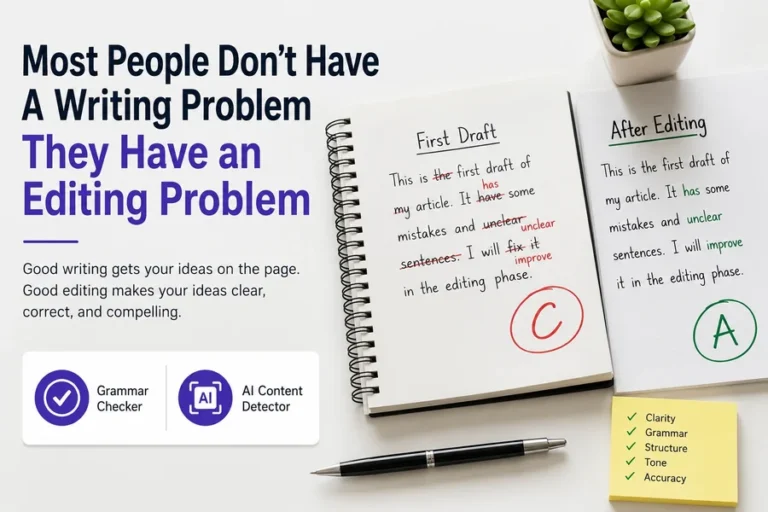
This is precisely why AI output should be the draft that humans heavily edit. It is good at giving your writing a shape; use it to mold something that is deeper, more interesting, and readable.
Change the length of the sentences, add more burstiness. Make the language easier to read by swapping out difficult words or common AI jargon. Add lived experience, quotes, and anything that makes the writing sound personal, warm, and more human.
Final Thoughts
Now that you know the common AI writing mistakes, they would be easier to spot and change. Whatever output is automated, it needs to be fact-checked and humanized before you can use it.
Take AI as your writing assistant. It is not there to do the whole job, but just to play the part that can make your writing faster and more efficient. Heavily edit the AI writing and make it more personal and relevant before using it.