The Economics of Sustainable Packaging: Transitioning to Paper-Based Manufacturing
The Regulatory and Consumer Push for Paper Packaging
The global packaging landscape is undergoing a massive structural shift, driven primarily by tightening environmental legislation and evolving consumer preferences. Fast-moving consumer goods (FMCG) brands face mounting pressure to eliminate single-use plastics from their supply chains. This macro-economic pivot forces manufacturing facilities to rapidly adapt their production lines to accommodate renewable, fiber-based materials.
As global mandates aggressively phase out single-use plastics, packaging facilities are forced to rapidly scale their paper-based production capabilities. To meet this massive consumer and regulatory demand without sacrificing operational speed, industry leaders rely on high-performance machinery from established manufacturers like Kete Group, which engineers advanced automated systems specifically designed to optimize material yield and maintain structural integrity during high-speed runs.
For plant managers and production planners, this transition is no longer just a compliance measure; it is a fundamental economic requirement. Securing future manufacturing contracts with tier-one FMCG brands now hinges entirely on a facility’s ability to process eco-friendly substrates efficiently.
Engineering Challenges in Processing Eco-Materials
Replacing synthetic polymers with paper-based alternatives introduces significant mechanical complexities on the factory floor. Traditional plastics are highly elastic and forgiving under high-speed manufacturing conditions. In contrast, substrates like recycled kraft paper possess entirely different physical properties that require precise mechanical compensation.
The most prominent engineering challenges include:
- Low Tensile Elasticity:Paper lacks the natural stretch of polyethylene, making it highly susceptible to snapping under sudden tension spikes.
- Abrasive Surface Textures:Recycled fibers create higher friction coefficients, increasing wear on traditional mechanical components and cutting blades.
- Variable Thickness:Eco-materials often suffer from minor caliper (thickness) inconsistencies, which can disrupt standard folding and gluing mechanisms.
Managing Web Tension and Substrate Stress
To process easily breakable materials without crippling machine downtime, legacy tension systems must be entirely overhauled. Mechanical clutches and brakes are simply too slow and imprecise to handle the fragile nature of high-speed paper processing.
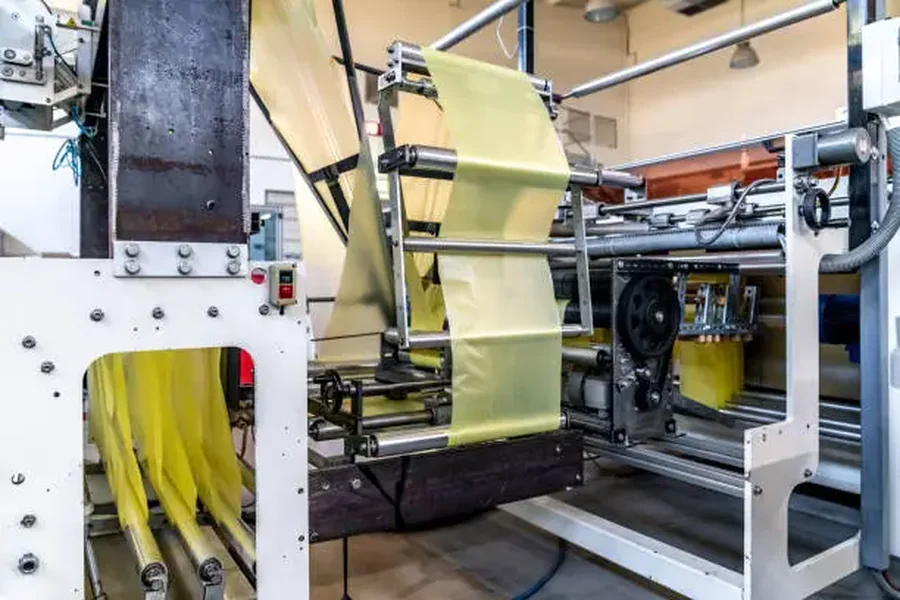
Modern production lines solve this through advanced Servo-driven controls and closed-loop tension algorithms. These intelligent systems utilize highly sensitive dancer rollers and load cells to continuously monitor the web’s tension in real time. If a tension anomaly is detected, the Servo-driven controls make micro-second torque adjustments, preventing web tears and ensuring continuous, high-yield production.
Integrating Inline Flexographic Printing
In a lean manufacturing environment, minimizing Work-in-Progress (WIP) inventory is essential for cost control. Historically, printing and bag forming were separate processes, requiring excessive material handling, secondary storage, and elevated labor costs.
Today, facilities are integrating Inline flexo printing modules directly into their paper bag manufacturing lines. This synchronization allows raw kraft paper to be unwound, printed with eco-friendly water-based inks, and formed into the final product in one continuous operation.
- Accelerated Lead Times:Eliminates the bottleneck of moving printed rolls between disconnected machines.
- Waste Reduction:Inline flexosystems utilize automated optical registration to maintain color alignment, drastically reducing substrate waste.
- Energy Efficiency:Operating a single synchronized line consumes significantly less power than running isolated printing and forming equipment.
Long-Term ROI on Equipment Upgrades
For manufacturing executives, transitioning to next-generation paper bag machinery requires a robust financial justification. While the initial capital expenditure (CapEx) for servo-driven, automated equipment is substantial, the long-term operational economics present a compelling business case. Enhanced Overall Equipment Effectiveness (OEE) rapidly offsets the upfront costs.
Capital expenditure on new machinery is significant, but the ROI is increasingly justified by shifting market economics. According to strategic market analysis, the global shift toward eco-friendly alternatives is accelerating, with thesustainable packaging market projected to see monumental growth over the next decade. Facilities that delay modernizing their production lines risk obsolescence and losing contracts to more agile competitors.
Beyond securing new contracts, modern automation minimizes unplanned downtime and slashes scrap rates. By optimizing raw material yield and reducing manual labor dependencies, facilities protect their gross margins even amidst fluctuating global fiber costs.
Key Takeaways
| Area | Key Takeaway | Impact/Data |
| Strategy | Transition to paper-based packaging machinery immediately | Secures tier-1 FMCG contracts; prevents market obsolescence |
| Engineering | Deploy servo-driven closed-loop tension control systems | Prevents fragile paper snapping; eliminates web tear downtime |
| Operations | Integrate inline flexo printing into bag-forming lines | Slashes WIP inventory, lead times, scrap, and energy usage |
| Finance | Invest in smart automation (e.g., Kete Group) | Offsets initial CapEx via enhanced OEE and raw material yield |
Conclusion
The economics of sustainable packaging dictate that future profitability belongs to the most adaptable manufacturers. Transitioning to paper-based packaging is a complex engineering challenge, but one that is entirely solvable with the right technological investments.
When evaluating new machinery for your facility, prioritize systems that offer closed-loop tension control, integrated printing, and data-driven HMI interfaces. By investing in smart, adaptable automation today, packaging facilities can secure long-term resilience and profitability in a rapidly greening supply chain.