
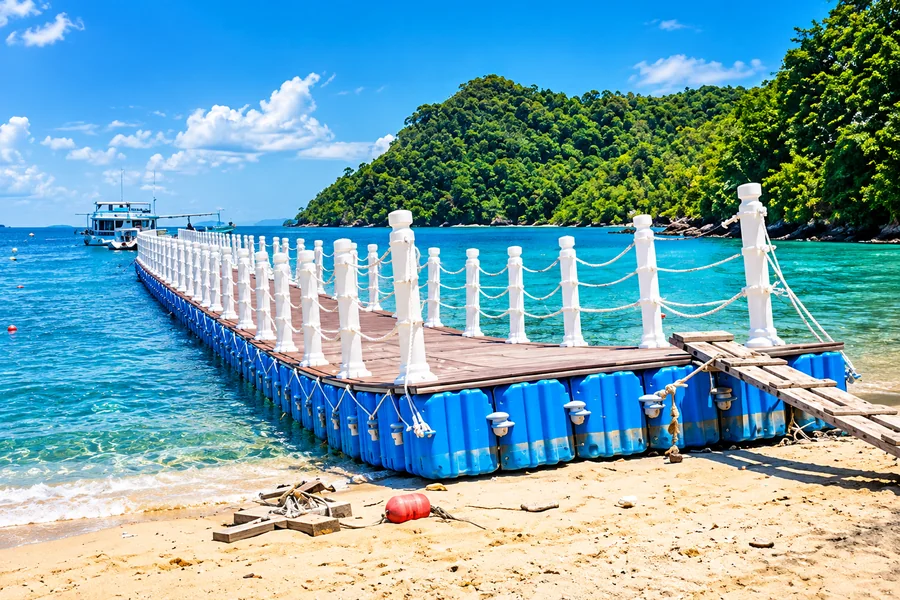
Floating Docks vs. Fixed Piers: Structural Terminology, Engineering Differences, and Waterfront Applications
Introduction
Choosing the correct marine infrastructure requires a clear understanding of coastal engineering terminology and material mechanics. Terms such as “floating docks,” “pontoons,” “fixed piers,” and “driven pilings” are frequently used interchangeably in informal discussions, yet they refer to fundamentally distinct structural systems.
For waterfront developers, civil engineering students, property owners, and technical copywriters, distinguishing between these concepts is vital. Selecting between floating and fixed structures dictates not only capital expenditure (CapEx) and installation timelines, but also determines long-term resilience against dynamic wave loading, corrosion, and fluctuating water levels.
Defining Key Technical Terminology in Marine Infrastructure
In modern coastal engineering, the term “modular floating dock” specifically refers to articulated pontoon platforms assembled from blow-molded thermoplastic units. Leading marine equipment manufacturers, such as Hisea Dock modular floating dock solutions, utilize high-molecular HDPE modules engineered with high tensile strength lugs ( thickness) to construct flexible pontoons that rise and fall automatically with tidal fluctuations.
Understanding foundational marine engineering concepts requires establishing clear technical definitions:
- Pontoon: A buoyant structure or enclosed chamber that relies on fluid displacement to support surface loads on water.
- Freeboard: The vertical distance measured between the water surface line and the upper deck of a floating platform.
- Deadweight Tonnage (DWT): The total weight capacity a floating structure can support safely before losing stability or submerged clearance.
Modular HDPE Floating Systems Defined
A modular HDPE floating system consists of individual, hollow High-Density Polyethylene cubes connected via heavy-duty composite locking pins. The core engineering advantage lies in dynamic buoyancy: as ambient water levels change, the platform adjusts automatically without requiring structural alterations.
Precise definitions ensure that engineers and business writers avoid ambiguity when drafting specifications. Technical writers frequently consult guides on grammar, definitions, and technical vocabulary to maintain linguistic accuracy in engineering documentation.
Fixed Pier Piling Mechanics
Conversely, a fixed pier relies on rigid structural support embedded directly into the seabed. Heavy wood, steel, or reinforced concrete posts—known technically as “driven pilings”—are hammered into soil or bedrock to support elevated cross-beams and decking planks.
Comparative Analysis: Engineering and Environmental Operational Criteria
Comparing floating pontoons against fixed piling piers requires analyzing structural flexibility, environmental adaptability, and site-specific hydrodynamic conditions.
Key engineering performance vectors include:
- Tidal Adaptation: Floating docks provide continuous fixed freeboard; fixed piers suffer from variable clearance as water levels shift.
- Wave Force Dissipation: Modular floating cubes flex slightly across interlocking joint lugs, absorbing wave kinetic energy, whereas fixed piers absorb severe impact forces directly into rigid structural pilings.
- Installation Velocity: Modular plastic pontoons assemble rapidly using basic hand tools, while fixed piers require heavy barge cranes and pile-driving equipment.
Load-Bearing Efficiency and Structural Flexibility
Commercial modular floating systems are engineered to achieve high displacement strength. Standard industrial-grade HDPE pontoon configurations provide a static load capacity of .
The articulated interlocking lug system allows individual cubes to move independently across microscopic tolerances under swell forces, preventing structural fatigue cracks across the primary platform deck.
Capital Expenditure (CapEx) and Life-Cycle Maintenance Concepts
Evaluating waterfront infrastructure investments requires a comprehensive Life-Cycle Cost Analysis (LCCA) that accounts for salt-water corrosion and periodic repairs. According to capital expenditure frameworks published by McKinsey & Company, transitioning to corrosion-resistant modular synthetic materials significantly lowers recurring operational maintenance costs compared to traditional wood or steel installations.
In financial engineering terminology, total cost assessment splits into initial procurement costs (CapEx) and recurring operational expenses (OpEx). Traditional wood or steel piers exhibit high long-term OpEx due to continuous anti-corrosion treatments, board replacements, and rustproofing.
Modular thermoplastic pontoon systems reduce OpEx to near zero. High-density polyethylene resists saltwater oxidation, wood-boring marine parasites, and UV degradation, delivering a stable lifecycle performance exceeding 15 years.
Effectively communicating financial and operational trade-offs requires mastery over corporate terminology. Technical professionals regularly review resources covering concept comparisons and professional language usage to build persuasive project proposals for executive stakeholders.
Conclusion: Selecting the Appropriate Waterfront Structure
Understanding the precise technical terminology and engineering distinctions between floating docks and fixed piers is essential for modern waterfront planning. While fixed piers remain suitable for deep-water commercial shipping terminals, modular HDPE floating pontoons offer superior versatility, lower lifecycle costs, and seamless tidal adaptation for residential and commercial marinas.
By evaluating project requirements through structural flexibility, CapEx/OpEx metrics, and environmental adaptability, decision-makers can select the optimal waterfront architecture for their specific marine applications.