Transition Into Agentic AI With 5 Programs Built for Working Professionals
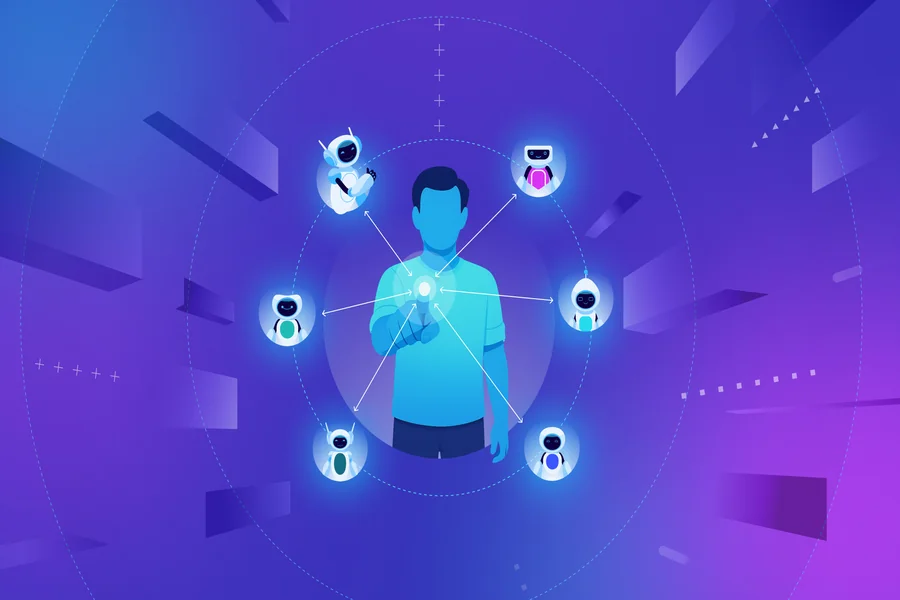
AI chatbots answer questions, but workplace AI is starting to take action. AI agents can review documents, search internal knowledge, update systems, prepare reports, route requests, and coordinate several steps without waiting for a new prompt each time.
This raises the bar for professional training. A useful course should cover retrieval, memory, tool use, workflow logic, multi-agent collaboration, evaluation, security, and the limits of autonomous systems.
The five programs below suit professionals who want to build technical agents or create no-code workflows that reduce repetitive work.
How We Selected These Online Courses on AI Agents
Agent Development: Each course had to cover agents, RAG, tools, automation, orchestration, or multi-agent systems.
Applied Work: Priority was given to projects, labs, case studies, and workflow builds.
Official Information: Program details were checked against official course pages.
Professional Fit: Online formats suited to working professionals were preferred.
Workplace Value: The selected courses support research, operations, support, analytics, content, and knowledge work.
Overview: Best Online Courses on AI Agents for 2026
| # | Course | Provider | Primary Focus | Delivery | Ideal For |
| 1 | Certificate Program in Agentic AI | Johns Hopkins University | Production-ready agents and multi-agent systems | Online | Technical and product professionals |
| 2 | Advanced Certification in Agentic AI Engineering | Edureka | Agent engineering and deployment | Live online | Developers and AI engineers |
| 3 | AI-Native Professional: Workflows & Agents for Productivity | Great Learning | No-code workplace automation | Live online | Functional professionals |
| 4 | IBM RAG and Agentic AI Professional Certificate | IBM on Coursera | RAG, tools, and orchestration | Self-paced | Data and software professionals |
| 5 | Building Agentic AI Systems | NIIT | End-to-end agentic applications | Mentor-led online | Project-focused learners |
1. Certificate Program in Agentic AI – Johns Hopkins University
This agentic AI course takes learners from LLM foundations to production-grade autonomous systems. It explains how agents reason, call tools, use external data, collaborate, and operate under monitoring and security controls.
Delivery & Duration: Online, 18 weeks.
Credentials: Certificate of Completion and 13 continuing education units.
Program Highlights: Faculty-led sessions, weekly mentor sessions, recorded lessons, 16+ live mentorship sessions, three projects, case studies, program support, and practice with 25+ tools and techniques.
Instructional Quality & Design: The curriculum covers Python, prompt engineering, RAG, DSPy, RAGAS, DeepEval, ReAct, MCP, Agentic RAG, LangGraph, CrewAI, AutoGen, A2A communication, observability, zero-trust security, Docker, and production deployment.
Key Outcomes / Strengths
- Builds single-agent and multi-agent applications.
- Covers evaluation, logging, tracing, hallucination checks, and security.
- Uses finance, research, underwriting, and automation projects.
2. Advanced Certification in Agentic AI Engineering – Edureka
Edureka follows an engineering-heavy path. Learners work across the agent application stack, from Python environments and APIs to orchestration, guardrails, deployment, and monitoring. It is better suited to people comfortable with coding.
Delivery & Duration: Live online, 60 hours, plus self-paced modules.
Credentials: Edureka Training Certificate, Graded Performance Certificate, and Certificate of Completion.
Program Highlights: Instructor-led classes, mentoring, 24×7 support, quizzes, assignments, 25+ practical use cases, and more than five industry projects.
Instructional Quality & Design: Topics include FastAPI, Streamlit, Gradio, LangChain, LangGraph, CrewAI, MCP, Agentic RAG, SQL agents, n8n, Langfuse, LangSmith, Docker, CI/CD, cloud deployment, and safety controls.
Key Outcomes / Strengths
- Develops production-style agent engineering skills.
- Connects tools, APIs, business data, and automated workflows.
- Provides substantial portfolio material for technical learners.
3. AI-Native Professional: Workflows & Agents for Productivity – Great Learning
This AI agents course is designed for professionals who want useful AI systems without becoming software developers. Each week produces a practical deliverable, such as a research bot, email assistant, competitor monitor, or specialized business agent.
Delivery & Duration: Live online, six weeks, with about three to four study hours per week.
Credentials: Professional Certificate from Great Learning.
Program Highlights: Weekly practitioner sessions, live projects, no-code automation, 10+ AI tools, build-along learning, one-year access to project files, and a workplace-focused capstone.
Instructional Quality & Design: Learners create reusable prompt systems, grounded research workflows, multi-tool content pipelines, Activepieces automations, knowledge bots, and rule-based agents. The final week covers responsible AI, reliability, troubleshooting, and live demonstration.
Key Outcomes / Strengths
- Requires no coding background.
- Produces a portfolio of working productivity systems.
- Connects research, content, communication, and automation tools.
4. IBM RAG and Agentic AI Professional Certificate – IBM on Coursera
This certificate suits learners with basic Python experience who want focused work with retrieval and agent frameworks. Its ten-course sequence combines lessons, labs, and projects in a flexible independent-study format.
Delivery & Duration: Self-paced online, about eight weeks at three hours per week.
Credentials: IBM Professional Certificate, shareable on LinkedIn.
Program Highlights: Ten courses, hands-on labs, RAG and multimodal projects, external tool integration, vector database exercises, a data visualization agent, and portfolio builds.
Instructional Quality & Design: Coverage includes LangChain, LangGraph, CrewAI, AG2, BeeAI, MCP, function calling, vector stores, multimodal RAG, tool chaining, APIs, Gradio, and multi-agent applications.
Key Outcomes / Strengths
- Strong focus on retrieval and tool-connected applications.
- Flexible for experienced independent learners.
- Introduces several orchestration frameworks.
5. Building Agentic AI Systems – NIIT
This 25-week program suits learners who want repeated project practice. It starts with Python and API development, then moves into conversational agents, RAG, stateful workflows, multi-agent collaboration, evaluation, and a production-style capstone.
Delivery & Duration: Online, mentor-led, 25 weeks.
Credentials: NIIT Professional Certificate. Optional CII certification and Academic Bank of Credits are available under the stated eligibility, registration, and fee conditions.
Program Highlights: Mentorship, 25+ tools and frameworks, portfolio projects, placement assistance for eligible learners, advanced RAG work, observability, safety, and measurable service-level objectives.
Instructional Quality & Design: Learners use Python, FastAPI, LangChain, LlamaIndex, LangGraph, CrewAI, Langfuse, Guardrails AI, PostgreSQL, Azure, and MCP-enabled tools. The capstone includes logs, evaluation reports, documentation, performance targets, and a live demonstration.
Key Outcomes / Strengths
- Provides a structured route from foundations to production.
- Treats reliability, privacy, monitoring, and cost as design requirements.
- Builds projects across support, finance, compliance, travel, and recruitment.
Final Thoughts
The best option depends on the workforce problem a professional wants to solve. The 18-week technical certificate suits those seeking depth in multi-agent design, evaluation, and production controls. The engineering program suits coders seeking deployment experience, while the six-week no-code option supports managers and functional teams seeking faster productivity gains.
The self-paced certificate offers a quicker route into RAG and orchestration frameworks. The 25-week mentor-led program allows more time for portfolio development. Across all five choices, the most useful agentic ai courses teach learners when to automate, how to measure reliability, and where human review must remain part of the workflow.