
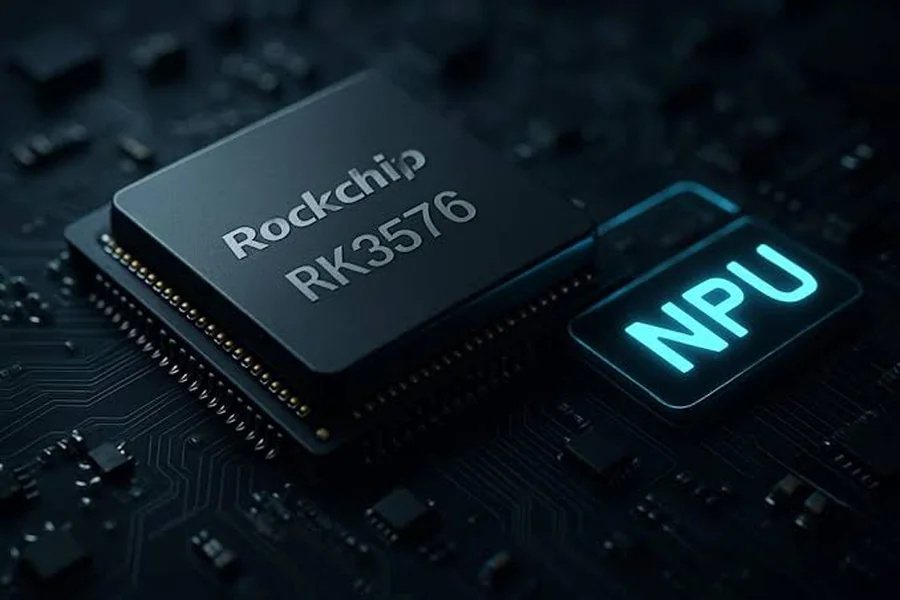
Rk3576: Rockchip’s Answer to the Middle Ground in Edge AI Hardware
For years, choosing a Rockchip processor came down to a simple tradeoff: budget-friendly basics or flagship power. The RK3576 breaks that pattern by targeting everything in between.
KiwiPi reports that Rockchip built the chip specifically for embedded systems that had outgrown entry-level processors but didn’t need the cost or complexity of a flagship SoC. That middle tier has been expanding rapidly as AI inference moves from data centers to the devices themselves.
Under the hood, the RK3576 runs an eight-core setup — four Cortex-A72 cores for heavier tasks paired with four Cortex-A53 cores handling background processes — manufactured on an 8nm node. A Mali-G52 MC3 GPU covers graphics needs like industrial interfaces and multimedia playback, while the standout component is a 6 TOPS neural processing unit built to run inference workloads such as speech recognition, defect inspection, and image classification without offloading them to the cloud. Memory support spans LPDDR4 through LPDDR5, and the multimedia hardware can decode 8K footage.
The reasoning behind this configuration comes down to what modern embedded hardware actually requires. A factory camera performing real-time object detection, a digital signage display running interactive AI recommendations, or a transit terminal handling payments and computer vision simultaneously — none of these need flagship-class computing. They need dependable multitasking, local AI processing, and power efficiency suited to devices that often stay in service for a decade.
Real products are already built around this logic. The ArmSoM Sige5 board uses the RK3576 to target robotics and AI edge development, leaning on its NPU and expansion options like PCIe and dual Ethernet. The Flipper One team went a different route, choosing the chip for a portable Linux computer after weighing power consumption, Vulkan support, and the chip’s improving upstream kernel compatibility — work being done in collaboration with Collabora rather than relying solely on vendor packages.
Set against the RK3588, the RK3576 concedes ground on CPU and GPU performance, since the flagship still uses Cortex-A76 cores and a stronger Mali-G610 GPU. But for developers building industrial controllers, smart kiosks, or AI cameras where longevity and efficiency outweigh peak benchmarks, the RK3576 offers a genuinely practical alternative rather than a scaled-down compromise.