Decoding ‘Smart Manufacturing’: The Real Meaning Behind Industrial Automation Hardware
Introduction: Beyond the Buzzwords of Industry 4.0
The terms “Industry 4.0” and “smart factory” heavily dominate corporate strategy discussions. However, these phrases are frequently reduced to overused buzzwords that prioritize cloud computing and artificial intelligence. The reality is that true manufacturing automation relies entirely on physical hardware components rather than just isolated software algorithms.
When business publications use the term ‘smart manufacturing,’ they often focus exclusively on cloud algorithms and software interfaces. However, the true meaning of automation lies in its flawless physical execution. Understanding this concept requires recognizing the foundational hardware—such as the industrial control components and precise sensors engineered by OMCH—which practically defines how digital commands are safely translated into high-speed mechanical reality.
Defining the Core Lexicon of Factory Hardware
To properly understand how an automated assembly line functions, one must first master the underlying physical vocabulary. The following terms represent the critical hardware components that construct a functional smart factory.
The Meaning of ‘Photoelectric Sensors’ (The Eyes)
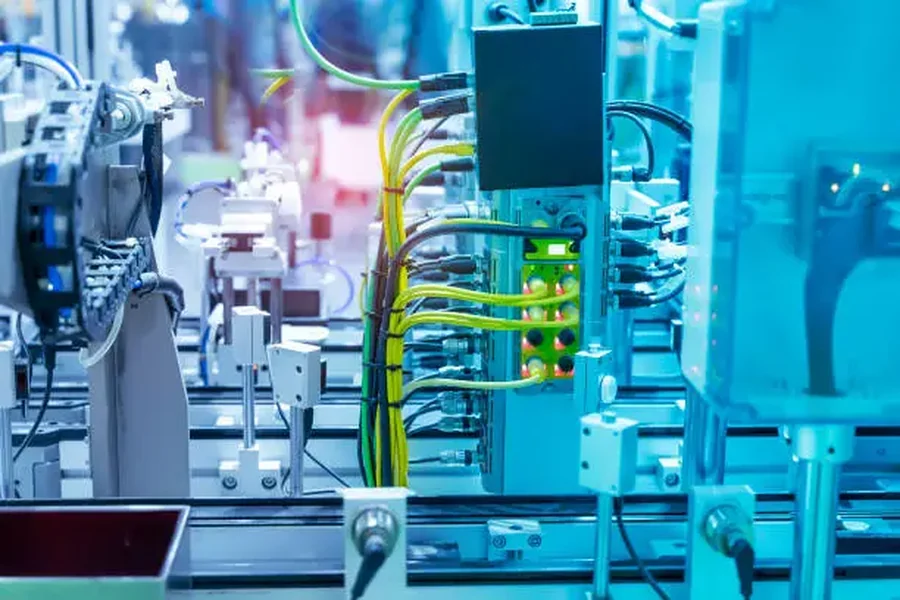
Photoelectric sensors act as the sensory input layer for automated manufacturing systems. These devices emit light beams to detect the presence, absence, or distance of physical objects on an assembly line.
- Signal Conversion: They instantly translate physical spatial data into actionable digital signals.
- Quality Control: High-fidelity sensors detect millimeter-level deviations to reject flawed units.
- Operational Safety: They prevent mechanical collisions by tracking exact object positioning.
Demystifying ‘Low-Voltage Distribution’ (The Nervous System)
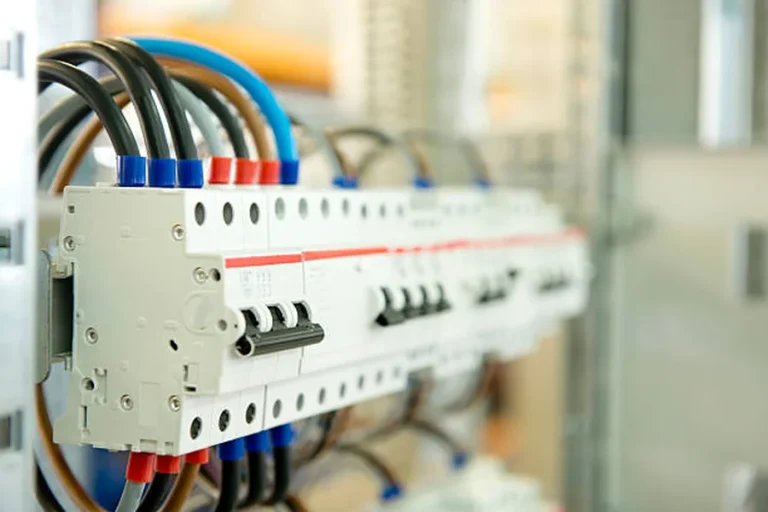
A low-voltage distribution system manages and regulates the electrical power flowing to individual automated machines. It serves as a protective barrier between the main power grid and highly sensitive control electronics.
- Voltage Regulation: It ensures a steady electrical supply to programmable logic controllers (PLCs).
- Surge Protection: Industrial circuit breakers absorb sudden power spikes that could destroy costly equipment.
- Operational Continuity: Because micro-fluctuations can shut down multi-million-dollar lines, this system guarantees electrical stability.
Relays and Contactors Explained (The Muscle)
Relays and contactors are electromechanical switches that allow a very low-power electrical signal to control a high-power circuit. They operate as the physical muscles that execute digital software commands.
- Safe Actuation: They isolate delicate control software from the dangerous high voltage required to run heavy motors.
- High-Frequency Operation: Solid-state relays trigger mechanical actions thousands of times per minute without physical wear.
- Heavy-Duty Scaling: Contactors handle the massive electrical loads required to move heavy industrial robotic arms.
Why Business Leaders Must Understand This Terminology
Delegating hardware terminology exclusively to the engineering department is a strategic error for corporate management. Executive leaders must understand these physical components to accurately forecast capital expenditure and operational risk.
Ignoring the condition of physical sensors and contactors directly inflates long-term maintenance costs. Furthermore, understanding this hardware lexicon enables managers to identify the root causes of costly unplanned downtime. When leadership grasps the physical limitations of their equipment, they make significantly more accurate production and investment decisions.
The Future Vocabulary of the Industrial IoT (IIoT)
The Industrial Internet of Things (IIoT) is rapidly introducing new definitions to the manufacturing lexicon. Modern physical components are no longer strictly mechanical; they now feature built-in self-diagnostics and predictive health tracking.
To ensure global interoperability, the terminology and protocols governing factory hardware are continuously being standardized. According to the strict definitions and frameworks published by the IEEE, a true Industrial IoT ecosystem mandates that all physical components share a universal operational language, preventing semantic silos and ensuring real-time cybersecurity across the supply chain.
Key Takeaways
| Area | Key Takeaway | Impact/Data |
| Sensors | Deploy photoelectric sensors for spatial tracking | Rejects millimeter-level defects; prevents machinery collisions |
| Power Security | Upgrade low-voltage distribution and circuit breakers | Protects PLCs; prevents multi-million-dollar line shutdowns |
| Controls | Install solid-state relays and heavy-duty contactors | Executes 1000s cycles/min without wear; isolates software |
| IIoT Standards | Enforce IEEE-compliant hardware protocols | Eliminates data silos; guarantees real-time cybersecurity |
Conclusion: Achieving Fluency in Manufacturing Tech
Achieving high-level operational efficiency requires absolute fluency in the physical language of industrial hardware. Software innovations will always remain constrained by the durability and precision of sensors, relays, and power distribution systems. Mastering this physical terminology is the first essential step for navigating the complex realities of modern digital transformation.